More Than Training.
More Independence.
More Peace of Mind.
A service dog can be so much more than a companion.
For someone living with a disability, medical condition, or psychiatric challenge, the right dog—paired with the right training—can become an incredible source of independence, confidence, security, and clarity.
They can be there in the moments when no one else is.
They can recognize changes in your body, respond when you are overwhelmed, retrieve something you cannot safely reach, create space when the world feels too close, or perform a trained task when you need assistance most.
At Legacy K9, our service dog training programs are built around one simple belief:
Your dog should not only know how to perform a task—they should understand how to help you navigate your life.
Every person is different. Every disability is different. And every service dog partnership should be different, too.
That is why our training is individualized around your needs, your lifestyle, your challenges, and the specific tasks that can make everyday life safer and more manageable.
The goal isn't simply a well-trained dog.
The goal is greater freedom. Greater confidence. And the peace of mind that comes from knowing you don't have to navigate every difficult moment alone.
Service Dog Training Services I Provide
YOUR DOG.
YOUR NEEDS. YOUR LIFE.
There is no one-size-fits-all service dog.
A task that completely changes one person's life may have little value to another. That's why our service dog programs begin with understanding you.
What parts of your day are difficult?
Where do you feel least independent?
What situations create the most concern?
What could a properly trained dog realistically do to help?
From there, we can build a training plan around appropriate disability-related tasks, obedience, public-access skills, handler communication, confidence, neutrality around distractions, and the reliability expected from a working service dog.
We aren't simply teaching commands.
We're building a partnership.
A partnership designed to help create more freedom where there were limitations.
More confidence where there was uncertainty.
More clarity when life feels overwhelming.
And more peace of mind knowing that wherever life takes you, you have a highly trained partner walking beside you.
Training Should Be Built Around All Three.
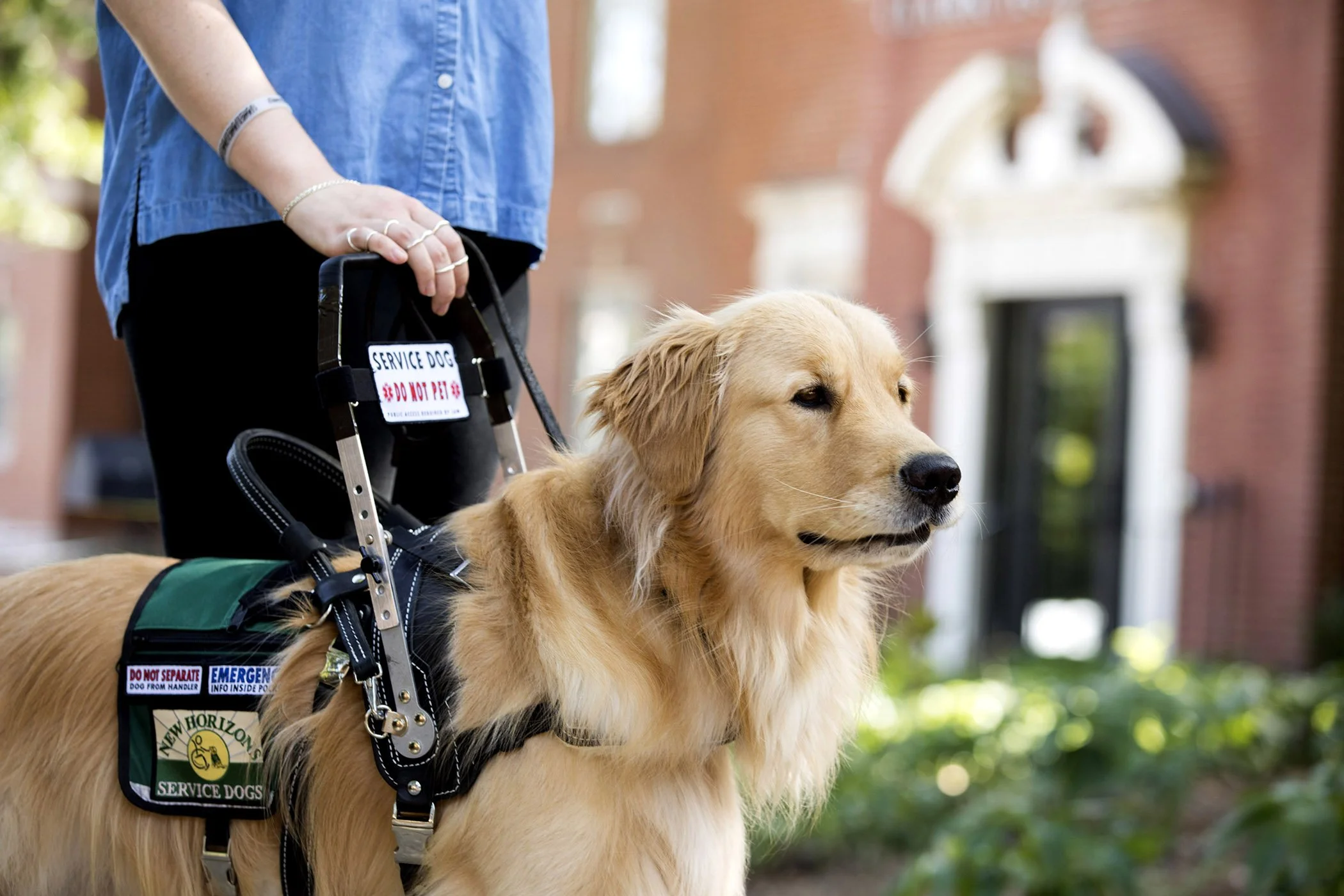
MORE THAN A SERVICE DOG.
A Partner in Your Independence.
There are things a service dog cannot change.
They cannot erase a diagnosis. They cannot replace your physician, therapist, medication, medical equipment, or emergency plan.
But they can be trained to help with specific pieces of life that your disability makes difficult.
And sometimes, those pieces add up to something much bigger.
The confidence to leave home.
The ability to complete a task independently.
A trained response during a frightening moment.
The freedom to participate more fully in everyday life.
The comfort of knowing you don't have to face every difficult moment by yourself.
That is what service dog training can be about.
Not simply teaching a dog how to work.
Teaching a dog how to help someone live with greater independence, confidence, and peace of mind.
ALLERGY & SCENT DETECTION SERVICE DOGS
An Extra Layer of Protection When Something You Cannot See Could Put You at Risk
For someone living with a severe or potentially life-threatening allergy, everyday situations can require constant awareness.
Food prepared by someone else. A restaurant. A school cafeteria. A shared kitchen. A product with an unclear ingredient list. Even a small amount of an allergen can create serious concern.
Through specialized scent training, a service dog may be trained to recognize the odor of a specific allergen and perform a trained alert when that scent is detected.
Depending on the individual's needs and the dog's capabilities, training may involve identifying target scents, alerting to their presence, checking certain items or environments, and maintaining reliable alert behaviors around distractions.
A trained allergy detection dog does not replace ingredient labels, medical devices, medication, emergency plans, or guidance from your healthcare team. Instead, the dog can become another carefully trained layer of awareness in daily life.
And sometimes, that additional layer can mean an incredible amount.
It can mean walking into an unfamiliar environment with more confidence. It can mean giving a parent another trained support system for their child. It can mean feeling that you have a partner beside you whose job is to pay attention to something you cannot always detect yourself.
That peace of mind can change the way you experience the world.
DIABETIC ALERT SERVICE DOGS
Support When Changes in Blood Sugar Can Affect Everyday Life
Managing diabetes can require constant attention.
Even with modern technology and careful management, changes in blood glucose can sometimes happen quickly or at inconvenient times—including while sleeping, working, exercising, or simply going about your day.
Diabetic alert training is designed to teach an appropriate dog to recognize specific scent changes associated with the handler's blood glucose changes and provide a consistent trained alert.
Depending on the person's disability-related needs, additional tasks may include retrieving a glucose kit or other needed item, seeking help from another person, or performing another individually trained response.
A diabetic alert dog should complement—not replace—continuous glucose monitors, blood glucose testing, medication, insulin, emergency supplies, and professional medical care.
But technology and companionship serve different roles.
A service dog can be beside you in the kitchen, next to your bed, walking through the grocery store, sitting under your desk, or traveling alongside you.
For the right handler, that partnership can provide something incredibly meaningful:
Another trained source of awareness—and another reason to feel less alone in the responsibility of managing a condition every single day.
DEEP PRESSURE THERAPY & PSYCHIATRIC SERVICE DOGS
Grounding Support When Your Mind and Body Feel Overwhelmed
Sometimes the hardest moments aren't visible to anyone else.
A person may look completely fine while internally experiencing panic, sensory overload, dissociation, escalating anxiety, or another disabling psychiatric symptom.
A psychiatric service dog can be trained to recognize specific behaviors or cues and respond with individually trained tasks.
One of those tasks may be Deep Pressure Therapy (DPT).
During DPT, the dog is trained to place controlled body weight or pressure against the handler in a specific way. For some handlers, this physical contact can serve as a grounding strategy during episodes of distress.
Depending on the handler's needs, a dog may also be trained to interrupt certain repetitive or escalating behaviors, provide tactile grounding, lead the handler toward a predetermined person or location, retrieve an item, or create physical space around the handler.
The greatest benefit can be the feeling of having a reliable routine during moments that otherwise feel unpredictable.
Your dog isn't judging the moment.
They aren't asking you to explain yourself.
They have been trained to recognize what you need and perform the task you have practiced together.
PTSD SERVICE DOGS
Helping You Reclaim Confidence, Independence & Everyday Life
PTSD can make ordinary environments feel extraordinarily difficult.
Crowded stores, unfamiliar places, being approached from behind, certain sounds or situations, sleep disturbances, or episodes of panic can make independence feel harder than it once did.
A PTSD service dog can be trained to perform specific tasks related to the handler's disability.
Those tasks may include interrupting escalating behaviors, providing tactile grounding or deep pressure, creating space around the handler, positioning behind or beside the handler in appropriate situations, guiding the handler toward an exit or predetermined safe location, retrieving an item, or seeking another person when trained to do so.
For some people, one of the most meaningful changes isn't a single task.
It's knowing someone is beside them.
It's being able to enter places that once felt overwhelming.
It's rebuilding routines.
It's gaining confidence one outing at a time.
It's having a trained partner who can respond consistently when symptoms make the rest of the world feel unpredictable.
A service dog cannot erase trauma.
But for the right person, a carefully trained service dog can become part of the process of reclaiming independence from it.
MOBILITY ASSISTANCE SERVICE DOGS
Making Everyday Tasks More Accessible
Many people perform hundreds of small physical tasks every day without thinking about them.
Picking something up from the floor. Carrying an item. Retrieving a phone. Opening an accessible door. Bringing an object from another room.
For someone living with a mobility-related disability, those seemingly simple actions can require significantly more effort—or may not be safely possible without assistance.
Mobility service dogs can be trained for individualized tasks such as retrieving dropped objects, carrying lightweight items, bringing specific objects, tugging open appropriate doors or drawers, closing certain doors, activating accessible buttons, and assisting with other carefully selected disability-related tasks.
The exact tasks depend on the handler, the dog, the environment, and what can be performed safely.
We place particular importance on safe mobility training. Tasks involving a handler placing significant weight on a dog's body require careful consideration because inappropriate bracing or weight-bearing can injure the dog. When appropriate, we focus on tasks that increase independence while protecting both handler and dog.
The result can be powerful.
Small tasks create independence.
And when a dog can help make dozens of those moments easier throughout the day, those small victories can add up to a dramatically different quality of life.
EPILEPSY & SEIZURE RESPONSE SERVICE DOGS
Trained Support During Vulnerable Moments
Living with epilepsy or another seizure disorder can bring uncertainty into everyday life.
For some handlers, service dog training focuses on what the dog can reliably do during or after a seizure.
A seizure response dog may be trained to retrieve a specific item, activate an accessible alert system, seek another person, remain nearby, or perform another individualized response appropriate to the handler's needs.
Some dogs may naturally demonstrate behavioral changes around seizure activity, but reliable advance seizure prediction is not something that should automatically be promised through training.
Our focus is on identifying trainable, repeatable tasks that can meaningfully assist the handler while maintaining realistic expectations about what a dog can and cannot reliably do.
For someone who experiences seizures, knowing that their dog has a practiced response can provide an important additional layer of support.
Because during one of your most vulnerable moments, your dog isn't simply standing beside you.
They have a job to do.
OCD PSYCHIATRIC SERVICE DOGS
Helping Interrupt Disabling Patterns & Reconnect With the Present
For some individuals, Obsessive-Compulsive Disorder can affect far more than thoughts.
Compulsions, repetitive behaviors, distressing cycles, or difficulty disengaging from certain routines can interfere significantly with everyday life.
When OCD substantially limits major life activities, a psychiatric service dog may be trained to perform specific tasks related to those disabling symptoms.
Depending on the individual, a dog may be trained to interrupt a particular repetitive behavior, provide a tactile cue, initiate a trained grounding behavior, retrieve an item, guide the handler toward a predetermined location or person, or perform another task identified as useful within the handler's broader treatment and coping plan.
The purpose isn't for the dog to "cure" OCD or simply provide comfort.
The purpose is to give the handler a trained, consistent response at moments when symptoms interfere with daily functioning.
Sometimes that interruption can help create a moment of clarity—a familiar cue from a trusted partner that helps the handler reconnect with what they have practiced.
CARDIAC & HEART-CONDITION SERVICE DOGS
Trained Assistance When Physical Symptoms Can Change Quickly
Living with certain cardiac conditions can make changes in heart rate, dizziness, weakness, fainting episodes, or other symptoms a significant concern in everyday life.
Depending on the individual's condition and needs, a service dog may be trained to perform specific response tasks such as retrieving a phone or emergency item, seeking another person, activating an accessible alert device, or assisting the handler with a predetermined response routine.
Some handlers also pursue scent- or behavior-based alert training for particular physiological changes. Because medical conditions and dogs vary significantly, alert capabilities must be evaluated individually and should never be represented as a replacement for prescribed monitoring or medical care.
The value of a cardiac service dog is not about replacing medicine.
It is about building another trained layer of support into the handler's life.
That can mean greater confidence while living independently, traveling, working, or participating in activities that may otherwise feel intimidating.
Sometimes peace of mind comes from something very simple:
Knowing your partner has been trained on what to do when you need help.